ResearchEducation & Skills
Will more recess help boys in school?
What we know for boys (and what we don’t)
Despite common (and intuitive) claims that recess may be especially important for boys’ engagement, outcomes, and behavior, the research base to back these claims is thin. Most rigorous studies either do not report results separately for boys and girls, or find effects that are small and inconsistent. Strengthening the research base will require larger, longer-term studies—ideally ones powered to detect effects by sex and that help us understand why and how some models work better than others.
Key takeaways
- The overall evidence is mixed and modest. Research on the impact of recess—especially for boys—is limited, and findings point in different directions. Even positive results tend to be small.
- Physical health shows the most promise. When recess lasts around 20 minutes and is well-organized, studies show modest but consistent gains in physical activity and some improvements in weight. However, most of this research focuses on younger children, and very few studies break out results by gender.
- Movement breaks can support focus, within limits. Short, structured activity breaks during the school day appear to improve on-task behavior, though effects are modest and don’t always replicate across studies.
- Structured recess may improve social dynamics. When adults play a more active role in organizing recess, there is some evidence of reduced bullying and better peer relationships. But causal evidence remains thin, and it’s unclear whether those gains persist over time.
- Academic effects are largely negligible. On average, recess does not appear to meaningfully affect test scores. A few studies have found small improvements, but null results are nearly as common.
- More and better research is needed. Existing studies tend to be small, short-term, and inconsistent in what they measure. Most critically, almost none report results separately for boys and girls.
Why it matters
Attention can be difficult for kids, and recess and other activity breaks can keep them engaged during class time. It can also be important for learning in its own right. Boys often lag girls in social and behavioral skills, and on the playground, kids learn to negotiate rules, cooperate, and get along. Greater focus and better peer relations can make teaching more effective and improve academic outcomes.
But school administrators face real tradeoffs. Education policy is typically focused on improving academic outcomes, and school leaders understandably respond by devoting more time to math and reading and less to recess or PE.
Between 1981 and 2002 the amount of time kids ages 6-17 spent weekly in outdoor activities declined by 50%, and the time spent on sports by 27%. In 2005, an National Center for Education Statistics (NCES) survey found that children in first grade received about 28 minutes of daily recess and about 1 in 10 elementary-school students did not have any scheduled recess at all.
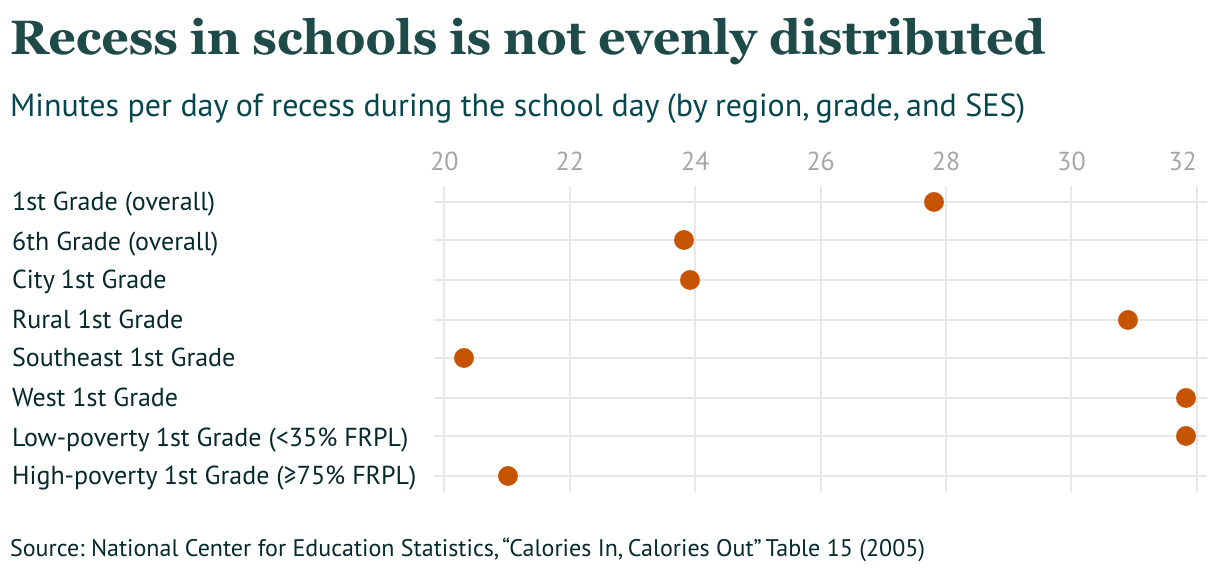
Figure 1
Following the No Child Left Behind Act (NLCB) in 2002, school districts reported a 42% increase in instructional time for math and language and a 2010 survey found that 20% of districts had reduced recess time to accommodate more testing. Today, the tide seems to be shifting again. Between 2006 and 2016 many school districts began requiring elementary schools to provide recess, and some states passed laws mandating at least some time for recess.
What we looked at
Below we summarize the evidence and identify some of the most rigorous and relevant studies on the effects of recess, highlighting differential impacts by gender where available. Many of the proposed mechanisms for improved behavior and academic outcomes flow through the increased physical activity that kids get from recess, so we look at outcomes across four domains—physical, academic, behavioral, and social. We also consider PE and classroom-based interventions when they illuminate mechanisms that might also be at work during recess.
The evidence in brief
Overall, there’s little evidence that more recess or physical activity harms children—for example, by displacing time that could be spent on academics. However, the evidence for benefits tends to be small and inconsistent, and studies measure many different outcomes, which makes it hard to summarize an overall effect. Large RCTs and quasi-experiments are rare and few studies disaggregate results by gender. Finally, while there are many theories about why more recess or increased physical activity is helpful, few studies test these theories or help us understand the underlying mechanisms.

Figure 2
Key evidence
Below we focus on high-quality randomized controlled trials, quasi-experiments, and meta-analyses. Our references section lists the complete set of literature that we consulted.
Texas Fitness Now quasi‑experiment (2007–11; over 1 million student-grade observations)
In one of the few interventions on middle-school (as opposed to elementary school) students, Packham & Street (2019) evaluated Texas Fitness Now (TFN), a four‑year, $37 million grant that mandated 30 minutes of daily PE for low‑income Texas middle schools. They find that the mandate failed to raise average fitness as measured by cardiovascular endurance, strength, flexibility, or average BMI. However, it did lower the proportion of obese students. Academically, math and reading scores were unchanged. They also report slightly lower attendance and more disciplinary reports, and suggest compulsory PE may deter some adolescents who dislike it. They find no differential effects by gender on physical, behavioral, or academic outcomes. An earlier, less rigorous analysis of TFN did find improvement on some measures of fitness but the benefits were greater for girls, possibly because girls tend to be less physically active outside of school.
Lifestyle of our kids (LOOK) 4‑year specialist‑PE trial, Australia (2005-09; 29 schools, 620 third graders)
From grades 3–5, children taught by PE specialists had smaller gains in body‑fat percentage and faster numeracy growth than peers with regular classroom‑led PE. Reading scores remained unchanged. After four years, follow-up found stronger bones and fewer students with high LDL (“bad”) cholesterol; boys’ LDL-C also fell. Social outcomes were not assessed.
Active Smarter Kids (ASK) cluster‑RCT, Norway (2014-15; 7‑month program, 57 schools)
In a cluster‑RCT of 1,129 Norwegian fifth‑graders, treatment schools added 165 minutes of weekly activity through active lessons, short classroom breaks, and active homework; controls kept their usual practice. Accelerometers showed no difference in total or school‑time activity, suggesting control pupils were already quite active. The authors found no overall change in numeracy, reading, English, or composite scores. However, children in the lowest third of baseline numeracy improved by 0.62 SD relative to controls, suggesting some benefits for the weakest students. Differences by sex were minimal with only a small reading difference favoring boys.
Fit & Vaardig 2-year cluster-RCT, Netherlands (2011-15; 12 schools, 500 students)
The Dutch Fit & Vaardig cluster‑RCT randomly assigned 12 elementary schools to receive either three 20-30-minute physically active math‑and‑language lessons or their usual instruction. Total instructional time stayed constant. After two years, the program improved spelling and math but not reading outcomes. For some outcomes (spelling and math speed), effects were weaker in year one and clearer by year two; general math gains were already evident in year one and persisted. The study did not report intervention effects separately for boys and girls, and social‑emotional metrics were not part of the trial.
Playworks cluster‑RCT (2010-11; 25-29 low‑income U.S. schools in 6 cities)
Playworks provides structured, adult-led recess to students in low-income schools and has been the focus of several evaluations. In one evaluation of 29 schools across 6 U.S. cities, over 1,500 4th and 5th-grade students wore accelerometers during recess. Those in treatment schools had significantly higher physical activity levels and were less likely to be observed sedentary than controls. Teachers also reported better student behavior. In an earlier evaluation, one school year of adults‑facilitated recess cut teacher‑reported bullying and exclusion by 43 percent and led to smoother class transitions relative to controls. However, no sex‑stratified analyses were conducted.
Howie et al., 2023 (13-study systematic review of elementary-age recess)
This review of 13 studies (8 quantitative, 5 qualitative, 11 from the U.S.) links longer recess to small gains in attention and teacher-reported behavior. There was no evidence linking greater recess-time to academic harm. The authors concluded that breaks of ≥20 minutes over multiple blocks may be optimal. This review did not look at physical or social outcomes or report sex‑stratified effects.
CDC, 2010 (50-study survey of school-based physical activity interventions)
Across 251 reported associations between activity and academic outcomes, just over half were positive, almost half null, and 1.5% negative. The authors concluded that “increasing time during the school day for physical activity does not appear to take away from academic performance.” Across seven interventions, six reported at least one positive association with behavior and none reported negative effects. Across six recess-focused studies of academic outcomes, all reported at least one positive association and none negative. Few studies reported gender-disaggregated results, and those that did found no consistent pattern.
Álvarez‑Bueno et al., 2017 (18-study meta-analysis of physical activity interventions)
This meta-analysis finds small positive effects on most academic domains, except language-related skills. The included interventions span PE, active lessons or breaks, and activity during recess or lunch, and the authors do not report sex-stratified results. They also find publication bias for some outcomes and note it cannot be ruled out for others.
A research agenda: moving from intuition to evidence
Current research on the educational benefits to recess and physical activity is hard to draw strong policy implications from. Most studies are small and short-term, and few are designed to build cumulative evidence about how recess affects outcomes like attention, behavior, or learning. The largest often find null effects. Only one meta-analysis has formally probed for publication bias (and found some), and few studies look at sex-differentiated effects or follow children beyond a single school year.
To move from intuition to actionable evidence, several priorities stand out:
- What is the optimal dose? How long, how often, and at what points in the school day do movement breaks matter most?
- Which works best? Unstructured recess, structured play, PE, or classroom movement?
- Who benefits? Are certain models especially beneficial for boys, lower-achieving students, or specific age groups?
- Do effects last? How does elementary-school recess exposure shape later health, behavior, and academic trajectories?
- Why does it work? Which mechanisms—attention regulation, peer dynamics, physical fitness—drive any observed gains?
We welcome rigorous evaluations that show what works, what doesn’t, and for whom. Promising directions include:
- Cluster-RCT of structured vs. unstructured recess, powered to detect effects for boys separately
- Design-based interventions (e.g., competitive games vs. cooperative play) to test whether effects differ by gender
- Long-run follow-up using administrative data linking recess exposure to attendance, discipline, and later achievement
If you’re piloting a new recess model, interested in adding gender-disaggregated analysis to an existing study, or looking for support to design and evaluate an intervention, we’d like to hear from you! Reach out through our contact form.
Subscribe to our newsletter
Get the latest developments on the trends and issues facing boys and men.
- Alvarez-Bueno, Celia, Caterina Pesce, Iván Cavero-Redondo, Mairena Sánchez-López, Miriam Garrido-Miguel, and Vicente Martínez-Vizcaíno. 2017. “Academic Achievement and Physical Activity: A Meta-Analysis.” Pediatrics 140 (6). https://publications.aap.org/pediatrics/article-abstract/140/6/e20171498/38200.
- Barenie, Matthew J., Erin K. Howie, Kari A. Weber, Deboleena Thakur, Christopher M. Murphy, and Michael R. Thomsen. 2024. “Where the Children Play: Gender Gaps in Recess Physical Activity by Age and Playground Area.” Preventive Medicine Reports 41:102699.
- Barros, Romina M., Ellen J. Silver, and Ruth EK Stein. 2009. “School Recess and Group Classroom Behavior.” Pediatrics 123 (2): 431–36.
- Behrens, Timothy K., Whitney M. Holeva‐Eklund, Carmen Luna, Dick Carpenter, Elizabeth Tucker, Julaine Field, and Cheryl Kelly. 2019. “An Evaluation of an Unstructured and Structured Approach to Increasing Recess Physical Activity.” Journal of School Health 89 (8): 636–42. https://doi.org/10.1111/josh.12787.
- Cawley, John, David Frisvold, and Chad Meyerhoefer. 2013. “The Impact of Physical Education on Obesity among Elementary School Children.” Journal of Health Economics 32 (4): 743–55.
- Centers for Disease Control and Prevention. 2016. “Results from the School Health Policies and Practices Study.” Division of Adolescent and School Health, National Center for HIV/AIDS, Viral Hepatitis, STD, and TB Prevention.
- Chang, Yu-Kai, Jeffrey D. Labban, Jennifer I. Gapin, and Jennifer L. Etnier. 2012. “The Effects of Acute Exercise on Cognitive Performance: A Meta-Analysis.” Brain Research 1453:87–101.
- Clevenger, Kimberly A., Britni R. Belcher, and David Berrigan. 2022. “Associations between Amount of Recess, Physical Activity, and Cardiometabolic Traits in US Children.” Translational Journal of the American College of Sports Medicine 7 (3): e000202.
- Donnelly, Joseph E., and Kate Lambourne. 2011. “Classroom-Based Physical Activity, Cognition, and Academic Achievement.” Preventive Medicine 52:S36–42.
- Eaton, Warren O., and Lesley R. Enns. 1986. “Sex Differences in Human Motor Activity Level.” Psychological Bulletin 100 (1): 19.
- Erwin, Heather, Alicia Fedewa, Jason Wilson, and Soyeon Ahn. 2019. “The Effect of Doubling the Amount of Recess on Elementary Student Disciplinary Referrals and Achievement Over Time.” Journal of Research in Childhood Education 33 (4): 592–609. https://doi.org/10.1080/02568543.2019.1646844.
- Hodges, Virginia C., Erin E. Centeio, and Charles F. Morgan. 2022. “The Benefits of School Recess: A Systematic Review *.” Journal of School Health 92 (10): 959–67. https://doi.org/10.1111/josh.13230.
- Howie, Erin K., Kristi L. Perryman, Joseph Moretta, and Laura Cameron. 2023. “Educational Outcomes of Recess in Elementary School Children: A Mixed-Methods Systematic Review.” Plos One 18 (11): e0294340.
- Infantes-Paniagua, Álvaro, Ana Filipa Silva, Rodrigo Ramirez-Campillo, Hugo Sarmento, Francisco Tomás González-Fernández, Sixto González-Víllora, and Filipe Manuel Clemente. 2021. “Active School Breaks and Students’ Attention: A Systematic Review with Meta-Analysis.” Brain Sciences 11 (6): 675.
- James-Burdumy, Susanne, Martha Bleeker, Nicholas Beyler, Rebecca A. London, Lisa Westrich, Katie Stokes-Guinan, and Sebastian Castrechini. 2013. “Does Playworks Work? Findings from a Randomized Controlled Trial.” Society for Research on Educational Effectiveness. https://eric.ed.gov/?id=ED563086.
- Juster, F. Thomas, Hiromi Ono, and Frank P. Stafford. 2004. “Changing Times of American Youth: 1981-2003.” Institute for Social Research, University of Michigan, Ann Arbor, Michigan 48106. https://www.nwf.org/~/media/PDFs/Eco-schools/teen_time_report.pdf.
- Kann, Laura. 2018. “Youth Risk Behavior Surveillance—United States, 2017.” MMWR. Surveillance Summaries 67. https://www.cdc.gov/mmwr/volumes/67/ss/ss6708a1.htm?s_hy_yrbs2017_adu.
- Lambourne, Kate, and Phillip Tomporowski. 2010. “The Effect of Exercise-Induced Arousal on Cognitive Task Performance: A Meta-Regression Analysis.” Brain Research 1341:12–24.
- Lee, Sarah M., Charlene R. Burgeson, Janet E. Fulton, and Christine G. Spain. 2007. “Physical Education and Physical Activity: Results From the School Health Policies and Programs Study 2006.” Journal of School Health 77 (8): 435–63. https://doi.org/10.1111/j.1746-1561.2007.00229.x.
- Lobelo, Felipe, Natalie D. Muth, Sara Hanson, Blaise A. Nemeth, Council on Sports Medicine, Fitness, Section on Obesity, et al. 2020. “Physical Activity Assessment and Counseling in Pediatric Clinical Settings.” Pediatrics 145 (3): e20193992.
- Massey, William V., Janelle Thalken, Alexandra Szarabajko, Laura Neilson, and John Geldhof. 2021. “Recess Quality and Social and Behavioral Health in Elementary School Students.” Journal of School Health 91 (9): 730–40. https://doi.org/10.1111/josh.13065.
- McMurrer, Jennifer, and Nancy Kober. 2007. Choices, Changes, and Challenges: Curriculum and Instruction in the NCLB Era. Centre on Education Policy.
- Mullender-Wijnsma, Marijke J., Esther Hartman, Johannes W. de Greeff, Simone Doolaard, Roel J. Bosker, and Chris Visscher. 2016. “Physically Active Math and Language Lessons Improve Academic Achievement: A Cluster Randomized Controlled Trial.” Pediatrics 137 (3). https://publications.aap.org/pediatrics/article-abstract/137/3/e20152743/81433.
- National Center for Chronic Disease Prevention and Health Promotion. 2010. “The Association between School-Based Physical Activity, Including Physical Education, and Academic Performance.” US Department of Health and Human Services Atlanta, GA, USA. https://sdcoi.org/wp-content/uploads/2018/01/cdc_executive-summary_associationbtwnpaandacademics.pdf.
- Owen, Katherine B., Philip D. Parker, Thomas Astell-Burt, and Chris Lonsdale. 2018. “Effects of Physical Activity and Breaks on Mathematics Engagement in Adolescents.” Journal of Science and Medicine in Sport 21 (1): 63–68.
- Packham, Analisa, and Brittany Street. 2019. “The Effects of Physical Education on Student Fitness, Achievement, and Behavior.” Economics of Education Review 72:1–18.
- Parsad, Basmat, and Laurie Lewis. 2006. “Calories In, Calories Out: Food and Exercise in Public Elementary Schools, 2005. ED TAB. NCES 2006-057.” National Center for Education Statistics. https://eric.ed.gov/?id=ED491691.
- Pawlowski, Charlotte Skau, Tine Tjørnhøj-Thomsen, Jasper Schipperijn, and Jens Troelsen. 2014. “Barriers for Recess Physical Activity: A Gender Specific Qualitative Focus Group Exploration.” BMC Public Health 14 (1): 639. https://doi.org/10.1186/1471-2458-14-639.
- Pellegrini, Anthony D. 2006. Recess: Its Role in Education and Development. Psychology Press. https://www.taylorfrancis.com/books/mono/10.4324/9781410613325/recess-anthony-pellegrini.
- ———. 2008. “The Recess Debate: A Disjuncture between Educational Policy and Scientific Research.” American Journal of Play 1 (2): 181–91.
- Ramstetter, Catherine L., Robert Murray, and Andrew S. Garner. 2010. “The Crucial Role of Recess in Schools.” Journal of School Health 80 (11): 517–26. https://doi.org/10.1111/j.1746-1561.2010.00537.x.
- Resaland, Geir K., Eivind Aadland, Vegard Fusche Moe, Katrine N. Aadland, Turid Skrede, Mette Stavnsbo, Laura Suominen, Jostein Steene-Johannessen, Øyvind Glosvik, and John R. Andersen. 2016. “Effects of Physical Activity on Schoolchildren’s Academic Performance: The Active Smarter Kids (ASK) Cluster-Randomized Controlled Trial.” Preventive Medicine 91:322–28.
- Robert Wood Johnson Foundation. 2010. The State of Play: Gallup Survey of Principals on School Recess. ERIC Clearinghouse.
- Ruhland, Stefanie, and Klaus W. Lange. 2021. “Effect of Classroom-Based Physical Activity Interventions on Attention and on-Task Behavior in Schoolchildren: A Systematic Review.” Sports Medicine and Health Science 3 (3): 125–33.
- Sallis, J F, T L McKenzie, J E Alcaraz, B Kolody, N Faucette, and M F Hovell. 1997. “The Effects of a 2-Year Physical Education Program (SPARK) on Physical Activity and Fitness in Elementary School Students. Sports, Play and Active Recreation for Kids.” American Journal of Public Health 87 (8): 1328–34. https://doi.org/10.2105/ajph.87.8.1328.
- Sallis, James F., Thomas L. McKenzie, Bohdan Kolody, Michael Lewis, Simon Marshall, and Paul Rosengard. 1999. “Effects of Health-Related Physical Education on Academic Achievement: Project SPARK.” Research Quarterly for Exercise and Sport 70 (2): 127–34. https://doi.org/10.1080/02701367.1999.10608030.
- Seljebotn, Per Helge, Ingrid Skage, Anette Riskedal, Marta Olsen, Silje Eikanger Kvalø, and Sindre M. Dyrstad. 2019. “Physically Active Academic Lessons and Effect on Physical Activity and Aerobic Fitness. The Active School Study: A Cluster Randomized Controlled Trial.” Preventive Medicine Reports 13 (March):183–88. https://doi.org/10.1016/j.pmedr.2018.12.009.
- Springer, Andrew E., Yasas Tanguturi, Nalini Ranjit, Katherine A. Skala, and Steven H. Kelder. 2013. “Physical Activity during Recess in Low-Income Third-Grade Texas Students.” American Journal of Health Behavior 37 (3): 318–24.
- Suga, Alessandra Cardozo Machado, Alexandre Augusto de Paula da Silva, Josieli Regina Brey, Paulo Henrique Guerra, and Ciro Romelio Rodriguez-Anez. 2021. “Effects of Interventions for Promoting Physical Activity during Recess in Elementary Schools: A Systematic Review.” Jornal de Pediatria 97 (6): 585–94.
- Telford, Richard D., Ross B. Cunningham, Robert Fitzgerald, Lisa S. Olive, Laurence Prosser, Xiaoli Jiang, and Rohan M. Telford. 2012. “Physical Education, Obesity, and Academic Achievement: A 2-Year Longitudinal Investigation of Australian Elementary School Children.” American Journal of Public Health 102 (2): 368–74. https://doi.org/10.2105/AJPH.2011.300220.
- Watson, Amanda, Anna Timperio, Helen Brown, Keren Best, and Kylie D. Hesketh. 2017. “Effect of Classroom-Based Physical Activity Interventions on Academic and Physical Activity Outcomes: A Systematic Review and Meta-Analysis.” International Journal of Behavioral Nutrition and Physical Activity 14 (1): 114. https://doi.org/10.1186/s12966-017-0569-9.
Related Research
Education & Skills
Why gender gaps in noncognitive skills matter in education
In this brief, Christopher Pulliam examines how gaps in noncognitive skills develop across childhood and how they are associated with educational attainment in adulthood.

Education & Skills
How pay and family patterns shape who teaches (and why there are so few men)
Michael Hansen and Diana Quintero take an in-depth look at how teacher pay and changing family patterns relate to men’s representation in the teaching profession.

Education & Skills
Gender gaps in school readiness are evident at kindergarten and vary by place
Based on kindergarten readiness scores in school districts across several U.S. states, Sadie Richardson, Sofia Wilson, and Sean Reardon find that that gender gaps are already present at school entry and vary across communities.