ResearchEmployment
Higher rents keep men at home

This is a summary of the working paper “Housing Costs, Parental Resources, and Declining Male Labor Force Participation” by Gabrielle Penrose, a graduate student fellow at AIBM.
Over the last several decades, prime-age men, especially those without a college degree, have faced stagnant wages, deteriorating health, and rising social isolation. They are also increasingly missing from the workforce. Economists have pointed to various explanations for the decline in work: automation, trade shocks, and the loss of manufacturing jobs. But these are only part of the story.
I focus on another explanation: housing costs. Since 1960, the rent for a one-bedroom apartment has risen by 150%(in real terms). The cost of owning has increased by about the same amount. The “price of independence” has risen sharply; meanwhile wages for non-college educated men have been flat. This means that for many men, living with mom and dad has become a more comfortable fallback. If this theory is right, we might expect more men to stay home as prices increase. This in turn may reduce the pressure to work.
Using census data, I study the causal impacts of higher housing costs in my paper “Housing Costs, Parental Resources, and Declining Male Labor Force Participation.” I find that:
- A 10% increase in local rents increases the likelihood that non-college men live with their parents by about 1.1 percentage points.
- The same rent increase is associated with a 0.5 percentage point decline in labor force participation.
- Initial estimates suggest that higher housing costs could explain a third of the employment decline among non-college men.
- Men living with their parents are 20 percentage points less likely to be in the labor force than those living independently.
- About 1 in 6 men without a college degree are living with their parents (16%), compared to 8% of men with a college degree.
- Men are much more likely than women to be living with parents (12% vs. 7%).
These findings have policy implications. By raising the price of independence, policies that restrict housing supply and raise housing costs may be an underappreciated driver of male labor force decline. Rahm Emanuel, the former Mayor of Chicago and likely presidential candidate, wrote recently that male despondency and rising housing costs are “two sides of the same coin.” My results suggest he may be onto something.

Figure 1
I find that the effects of rising rents concentrate exactly where the theory predicts. Younger men (ages 25–34) show strong responses to housing costs; older men (45–54) show none—likely because their parents may no longer be alive or able to provide support. Unmarried men respond strongly; married men do not, since moving a spouse into a childhood bedroom is rarely a viable option. And men without college degrees are far more affected than college graduates, whose higher earnings make independent living more affordable. These patterns reinforce the core finding: when the price of independence rises, men who have a realistic fallback—the parental home—are more likely to take it.
How do we know this is causal, and not just correlation? Simply comparing employment in expensive and cheap cities won’t work—rents are higher where jobs are plentiful, which masks the true relationship. To account for this, I use geographic constraints on housing supply (mountains, coastline, lakes) that drive up rents independent of local job markets.
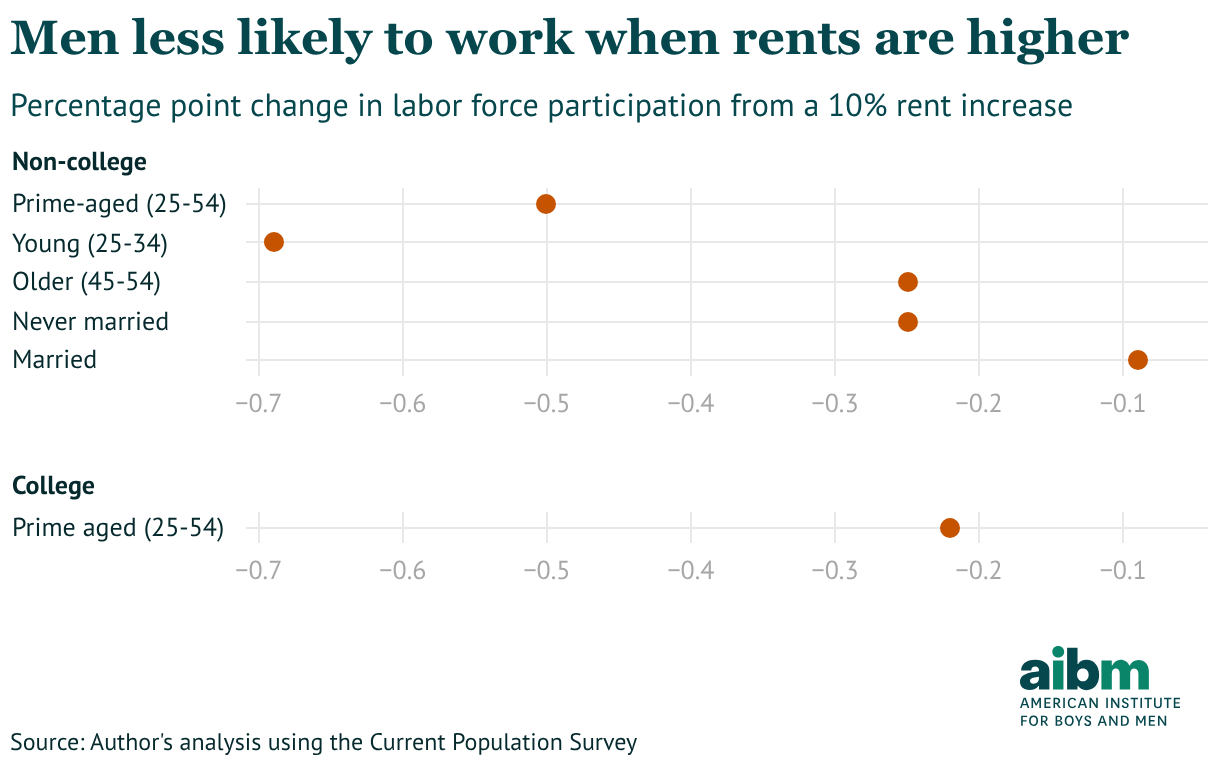
Figure 2
The pattern for labor force participation mirrors the co-residence results. A 10% increase in rents is associated with a 0.5 percentage point decline in participation for non-college men—with effects concentrated among younger and unmarried men.
Initial calculations suggest housing costs could explain around a third of the overall participation decline for this group, though further structural modeling (in progress) will sharpen this estimate.
Men at home, men out of work
Trends over the last six decades are stark, especially for men without college degrees. In the 1960s men with and without college degrees tended to work and live with their parents at similar rates (Figures 3 and 4). Since then, a sharp divergence has emerged. Non-college educated men have seen a 12 percentage point decline in participation, while the rates at which they live with parents have nearly tripled. College-educated men have seen far smaller changes on both margins.


Figures 3 and 4
Men much more likely to live with parents
Rates of living with parents have risen for both men and women, particularly since 2000. But the magnitudes differ substantially. By 2024, prime-age men lived with their parents at approximately double the rate of prime-age women (Figure 5). Part of this gap reflects that women are more likely to have children at home, which makes moving in with parents harder. Women’s labor force participation has also been shaped by other forces over the past sixty years, most notably by the dramatic rise in women’s participation through the 1990s (Figure 6). In this project, I focus on men where these other factors are less confounding.


Figures 5 and 6
Men living with parents work less
Where men live and whether they work are tightly linked. Men living with their parents without a college degree are 20 percentage points less likely to be in the labor force than those living independently. Another way to think about this is that if we set aside men living with their parents entirely, the decline in non-college educated male participation since 1960 would be three percentage points smaller than what we actually observe (Figure 7).

Figure 7
An alternative interpretation is that these trends simply reflect a weak labor market. Men lose jobs and move home while they search. Under this view, living at home is a launchpad: a place to regroup before returning to work.
Of course, some men do move home after losing a job and while they look for work. But this can’t explain the trends we observe. Among non-working men living at home, a quarter have never held a job at all—up from one in five in 1980 (Figure 8). These are not men actively searching for work or upskilling from their childhood bedroom. They appear to have disengaged from the labor market entirely.
And it’s not just young men. In the 1960s, living with parents was largely confined to men in their early twenties and fell sharply with age. By 2025, the entire age profile has shifted upwards (Figure 8). Roughly one in five non-college men in their early thirties live with their parents, and rates remain high into their forties.
This pattern suggests that co-residence today functions less as temporary insurance and more as a permanent alternative to economic independence.


Figures 8 and 9
It’s not just the demand side
If living with parents were just a response to weak labor demand, participation should stabilize when wages do. But earnings for non-college men have been flat for decades, even as participation has continued to fall. At the same time, housing costs have outpaced those wages, and the rise of dual-earner households means parents are better positioned to support adult children. Understanding male labor force declines requires looking further than labor demand to the changing economics of independence.
The bottom line: housing policy can be labor market policy
The evidence points to structural explanations for the increase in the share of men who have not flown the parental nest, and who are out of the labor market. One reason more men are living with parents and leaving the workforce is because the economics have changed. This is a rational response to stagnating wages, rising housing costs, and a difficult path to independence—especially for men without a college degree.
Families provide crucial informal insurance, but that insurance may come with a cost: men living at home may have a reduced incentive to work. Policies that restrict housing construction thus inadvertently weaken labor force participation by raising the price of independence. Expanding access to affordable housing near jobs, particularly for lower-income adults, may therefore play a role in supporting labor market participation, especially among working class men.
Subscribe to our newsletter
Get the latest developments on the trends and issues facing boys and men.
Related Research

Employment
Men enter teaching to pay it forward
Ben Smith and Jennifer Seelig present findings from a study, in partnership with NORC at the University of Chicago, on the motivations of male teachers and the barriers they faced when entering the profession.

Employment
Healthcare is the new working-class jobs engine. Can it become a career pathway for men?
While healthcare has emerged as the dominant replacement sector for manufacturing in the U.S. since the early 1980s, much of its growth is concentrated in roles that many men have not historically viewed as natural occupational pathways.

Employment
Dads are taking more parental leave than the headlines suggest
As state paid family leave programs have expanded rapidly across the United States, Anders Knospe and Richard Reeves find that fathers' leave-taking has grown dramatically, and that the gap between fathers and mothers is narrower than standard measures suggest.