ResearchEducation & Skills
Boys start school behind girls, and the gaps are widest for those struggling most

This research snapshot summarizes Benjamin M. Smith’s article in Educating Boys: Bridging Gaps, Building Futures, a special volume of The ANNALS of the American Academy of Political and Social Science.
Key questions
Where do boys fall behind in K–12 education, and how do these gaps vary by age and achievement level? Using nationally representative longitudinal data, five decades of national assessments, and international comparisons, the article traces gender gaps in reading, math, behavior, discipline, disability identification, grades, and high school completion. It shows how these gaps vary by age, over time, and across the achievement distribution, providing a common empirical picture for understanding where boys’ educational challenges are most pronounced.
Key takeaways
- Girls arrive at kindergarten ahead of boys in reading, and the gap persists through high school. Girls have outscored boys on national reading assessments at ages 9, 13, and 17 in every round since the early 1970s, and in virtually every country tested internationally. Among 12th graders at the 10th percentile, girls lead by 0.37 standard deviations (SD), nearly three times the gap at the 90th percentile.
- Boys’ advantage in math is smaller, emerges later, and is less uniform. Differences are near zero at school entry. For much of the past two decades, boys’ average advantage on national assessments in grades 4, 8, and 12 was between 0 and 0.10 SD. That advantage widened after 2020 as girls’ scores declined more sharply.
- The biggest gaps are behavioral. Kindergarten teachers rate girls about 0.45 SD higher on attentiveness, persistence, and eagerness to learn. That gap grows to 0.59 SD by fifth grade and rivals differences by race and class.
- Boys earn a 3.0 average high school GPA compared to 3.23 for girls, and they make up two-thirds of the bottom 10% of GPAs but only one-third of the top.
- Boys are 65% of special education students and are suspended at higher rates than girls in every racial group.
Key figure
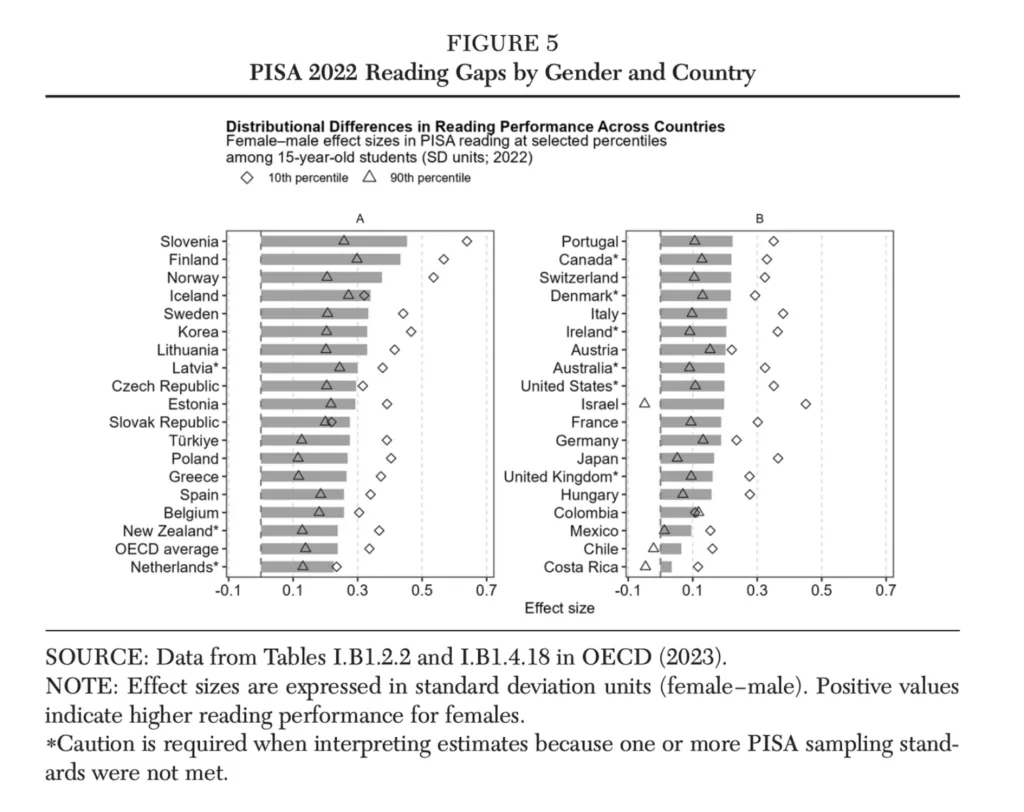
Across countries participating in PISA 2022, girls generally outperform boys in reading, with the largest gaps often appearing among the lowest-performing students. The consistency of this pattern across different education systems suggests that boys’ reading difficulties extend beyond features specific to American schools. The size of the gap nevertheless varies across countries. This pattern is consistent with an interaction between boys’ development and their learning environments.
About The ANNALS
Educating Boys: Bridging Gaps, Building Futures is a special volume of The ANNALS of the American Academy of Political and Social Science. First published in 1890, The ANNALS brings together research on specific social challenges to inform scholarship and public policy.
Co-edited by Richard V. Reeves, Pedro Noguera, and Ioakim Boutakidis, Volume 716 examines boys’ educational outcomes, possible explanations for their difficulties, and promising responses from schools and policymakers. Difficulties in school can signal challenges that follow boys into employment, family life, and well-being, making education an important setting for early intervention. Contributions span early learning and classroom relationships, mentoring, career and technical education, and school accountability, alongside perspectives from education leaders.
Subscribe to our newsletter
Get the latest developments on the trends and issues facing boys and men.
Related Research

Education & Skills
Why gender gaps in noncognitive skills matter in education
In this brief, Christopher Pulliam examines how gaps in noncognitive skills develop across childhood and how they are associated with educational attainment in adulthood.

Education & Skills
How pay and family patterns shape who teaches (and why there are so few men)
Michael Hansen and Diana Quintero take an in-depth look at how teacher pay and changing family patterns relate to men’s representation in the teaching profession.

Education & Skills
Gender gaps in school readiness are evident at kindergarten and vary by place
Based on kindergarten readiness scores in school districts across several U.S. states, Sadie Richardson, Sofia Wilson, and Sean Reardon find that that gender gaps are already present at school entry and vary across communities.