ResearchEducation & Skills, Employment
Data Spotlight: Men are losing out on healthcare jobs. Is it time for action?

Earlier this month, the Bank of America Institute reported that women captured the large majority of U.S. job gains in 2025—a finding picked up widely, including by Axios.
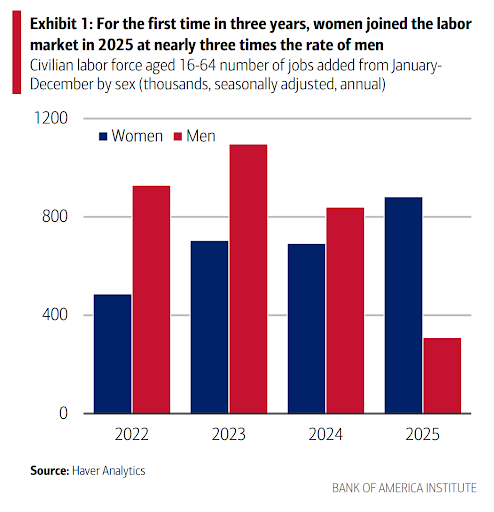
Figure 1
In particular, most job growth in 2025 is coming from the healthcare industry, as the Bank of America Institute report mentions and that we find in our own analysis.

Figure 2
That concentration—77% of total positive sector contributions—is what explains the gender story. It is not that women outcompeted men broadly; it is that the sector adding the most jobs employs a workforce that is roughly three-quarters women, while the construction, manufacturing, and transportation sectors, where men are in the majority, were flat or negative.
This is not without precedent. While it is important not to put too much weight on short-term job changes, especially given the likelihood of future revisions, there are some longer-terms trends visible here, ones that could leave many men struggling in the labor market.
Healthcare and education tend to be more resilient sectors of the economy. They hold up or grow during economic slowdowns, while goods-producing industries contract. The 2025 pattern looks like a mild version of what happened during and after the 2008–09 recession. Whether it signals a similar dynamic—or something new—remains to be seen.

Figure 3
What makes this worth watching is the long-run trajectory. As Richard Reeves and I noted in our brief on the HEAL economy, healthcare jobs are projected to be among the fastest-growing occupations over the next decade. They pay reasonably well, overall. And they currently employ relatively few men which makes them a real opportunity worth taking seriously for boys and young men thinking about careers. Getting men into HEAL jobs is not just about improving gender diversity in those roles, it is about helping men find good jobs.
Subscribe to our newsletter
Get the latest developments on the trends and issues facing boys and men.
Related Research

Education & Skills, Employment
Will more recess help boys in school?
Does recess help boys in school? A research summary on behavior, focus, learning outcomes, and what the evidence shows.

Education & Skills, Employment
Data Spotlight: Gender gaps across life
U.S. gender gaps across life: men lag in education, health & incarceration; lead in earnings & employment. See the age-by-age data.

Education & Skills, Employment
“School’s not cool”: How peer pressure can hurt boys’ education
Peer pressure and masculine norms discourage boys—especially disadvantaged ones—from visible academic effort, widening education gaps.