ResearchEducation & Skills
“School’s not cool”: How peer pressure can hurt boys’ education

This is a summary of ongoing research by the authors.
Across the United States, boys are falling behind girls in education. They earn lower grades, are less likely to graduate from high school, and enroll in college at significantly lower rates. This issue is especially severe among disadvantaged students: boys from lower-income backgrounds face some of the steepest academic challenges of any demographic group.
Conventional accounts often attribute these differences to boys’ lower “non-cognitive skills”—attentiveness, persistence, and self-regulation—which are seen as mismatched with school environments. But an alternative and understudied explanation may be even more consequential: boys perceive academic effort as in conflict with a “masculine” identity.
Working hard in school, demonstrating conscientiousness, and visibly striving for good grades can be coded as feminine, weak, or disloyal to one’s peer group. When this happens, boys face what amounts to a “psychological tax” on investing in their own education. Our new experimental evidence shows that this dynamic is real.
The experiment: Public vs. private educational choices
We reanalyzed data from a field experiment originally conducted by Leonardo Bursztyn and Robert Jensen in high schools in a disadvantaged area of Los Angeles. Students were offered the opportunity to sign up for a free SAT preparatory course, a clear educational investment that could benefit their future college prospects.
The key experimental manipulation was straightforward but insightful: some students made their sign-up decision privately, while others did so in a “public” setting, where their choice would be shared with classmates. If students genuinely wanted the SAT prep course for its educational value alone, whether the decision was made publicly or privately shouldn’t matter. However, if students worry about peer judgment of their academic effort, the public condition should lead to fewer sign-ups.
The original study found a strong peer effect among students in non-honors classes; that is, those from less academically driven peer groups. Those students were much less likely to enroll in the educational opportunity when their choice was visible to their classmates.
What we wanted to know was: Does this peer effect also press more heavily on boys?
Methods and results
The experiment was conducted in the four largest public high schools in a disadvantaged area of south Los Angeles between December 2013 and April 2014. These schools serve predominantly Hispanic students from lower-income backgrounds. Within each school, there are two types of classes: honors and non-honors. As mentioned, the original study found significant treatment effects only in non-honors classrooms. These are environments where academic effort may be more stigmatized.
Here we focus our gender analysis on this subsample of 560 students.
Students were randomly assigned within classrooms to either the private condition (N=279) or the public condition (N=281). As expected from the within-classroom randomization, the two groups are very well balanced on all measured factors, including gender, age, ethnicity, prior coursework, and GPA.
In the private condition, students were told their sign-up decision would stay confidential. In the public condition, students were informed that their decision would be shared with classmates. This within-classroom randomization ensures that students in both groups face the same educational opportunities and peer environments, with the only difference being whether their choice is observable.
We find that when educational choices are private, boys and girls enroll in the SAT prep course at similar rates. But when choices become public, boys are much less likely to sign up, while girls barely change their behavior.
As in the original study, the public condition reduces sign-up rates by 10.8 percentage points overall (p<0.01). But as the other bars show, this effect appears to differ by gender. For girls, the decrease is 8.4 percentage points and is not statistically significant.
The figure below shows the main regression results.
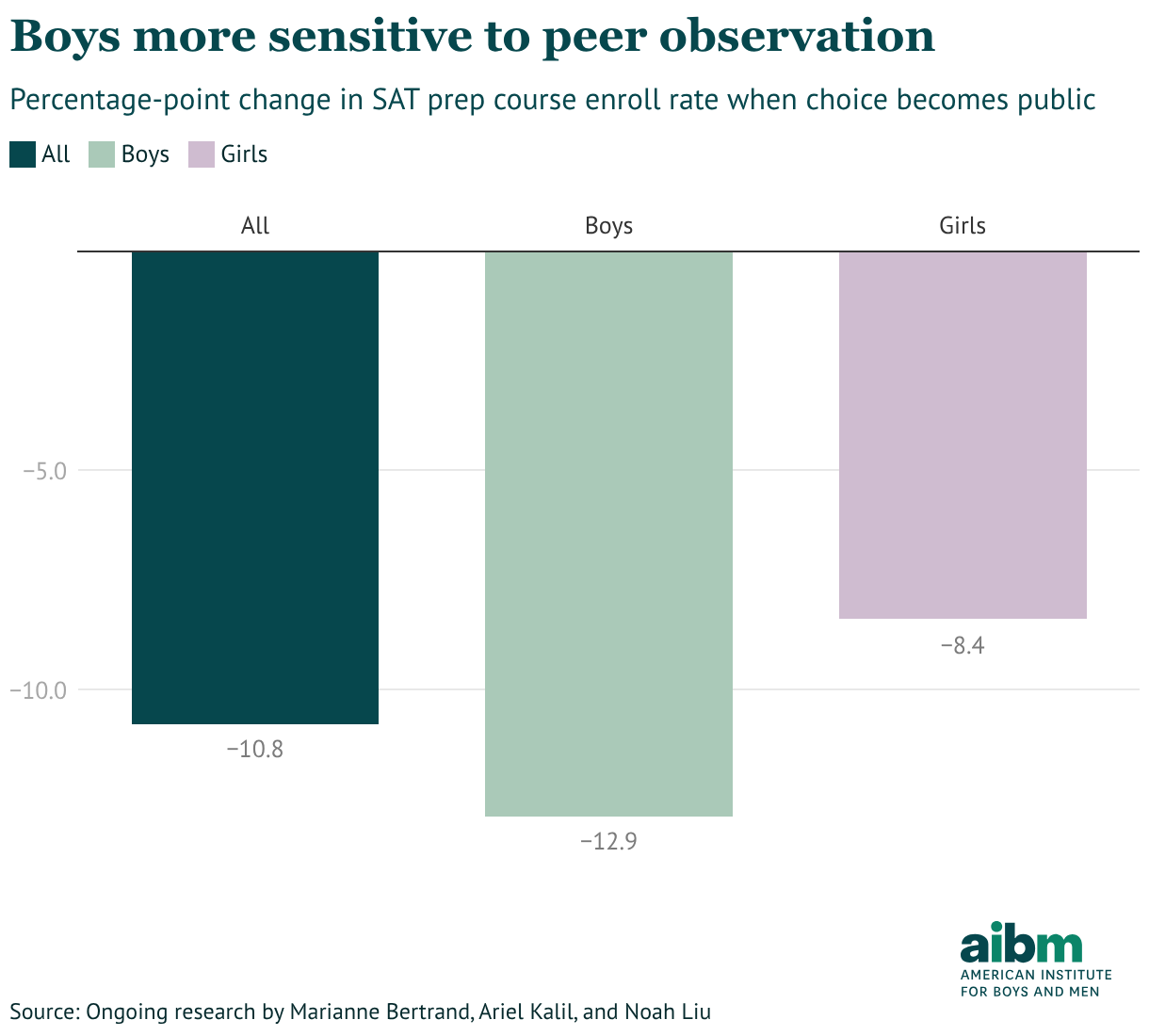
Figure 1
In short, the assumed “peer effect” is only statistically significant for boys, and roughly 50% larger in magnitude than for girls. While the difference between the two estimates is not statistically significant, this pattern suggests that boys are more vulnerable to the social costs of visible academic investment. When no one is watching, they’re willing to pursue educational opportunities. But when peers can observe their choices, they retreat, possibly to avoid the stigma associated with academic effort.
Why does this matter?
These findings highlight a specific, addressable mechanism behind boys’ educational underperformance. The obstacle may not be that boys don’t value education or fail to understand its benefits. Instead, they face social pressure that discourages them from openly investing in their futures.
This interpretation aligns with economists’ focus on “social image concerns” and psychologists’ interest in “identity-based motivation”: students regulate their behavior to align with the identities they value and the peer groups they seek approval from. If masculine status is constantly earned and protected, boys might reject behaviors seen as feminine, including academic effort and conscientiousness, to prove their masculinity. The main idea is that this process works through identity and perceived peer norms, not just personal beliefs.
Implications for schools and policy
If masculinity norms in relation to educational investments constitute a significant barrier to the progress of boys and young men, what can schools do about it?
Our findings suggest some promising directions.
- First, lessons from interventions that shift perceived peer norms by reducing pluralistic ignorance can be applied here. If boys learn that most of their peers actually respect academic effort (rather than stigmatizing it), the social costs of educational investment would decrease.
- Second, role-model interventions have proven effective in adjacent domains—for example, brief visits from successful female alumni nearly doubled women’s likelihood of majoring in economics—suggesting that analogous approaches featuring men who embody masculinity while credibly endorsing academic effort could shift boys’ perceptions of whether effort is compatible with masculine identity.
- Third, understanding which school contexts amplify these pressures could help target resources where they’re most needed.
More broadly, our research offers a reframing of the “boy problem” in education. The challenge isn’t simply that boys lack motivation or non-cognitive skills. Instead, they face a social environment that penalizes visible academic effort. This penalty falls disproportionately on those who can least afford it. Identifying and addressing these identity-based constraints may be essential for closing gender gaps in education and expanding economic mobility.
Subscribe to our newsletter
Get the latest developments on the trends and issues facing boys and men.
Marianne Bertrand is the Chris P. Dialynas Distinguished Service Professor at the University of Chicago Booth School of Business, where she directs the Inclusive Economy Lab.
Ariel Kalil is the Daniel Levin Professor at the University of Chicago Harris School of Public Policy, where she directs the Behavioral Insights and Parenting Lab.
Noah Liu is a PhD student at the University of Chicago Harris School of Public Policy.
Related Research

Education & Skills
Will more recess help boys in school?
Does recess help boys in school? A research summary on behavior, focus, learning outcomes, and what the evidence shows.

Education & Skills
Data Spotlight: Gender gaps across life
U.S. gender gaps across life: men lag in education, health & incarceration; lead in earnings & employment. See the age-by-age data.

Education & Skills
How NEETs spend their time
How young people not in work or school spend their days—and why NEET men’s leisure time and isolation matter for norms, policy, and work.