ResearchFatherhood & Family, Employment
Dads are taking more parental leave than the headlines suggest

As state paid family leave programs have expanded rapidly across the United States, a question has taken on new urgency: are fathers actually taking parental leave? There’s a widespread sense that they don’t take much—and the most rigorous recent analysis, a working paper from the Minneapolis Federal Reserve using the American Community Survey (ACS), appears to confirm it. Among its headline findings:
- 95% of fathers take zero weeks of leave.
- Fathers take an average of just three days (0.6 weeks) of paternity leave—compared with 7.2 weeks for mothers.
- Paternity leave duration has remained flat in recent years.
- Paid family and medical leave programs have done little to substantially increase fathers’ leave-taking.
The three-days figure in particular has been cited widely as a sign of how little leave fathers use, echoing a broader pessimism about fathers and leave.
We think this picture is incomplete and not up to date. Incomplete, because the Fed’s measure counts only full weeks of complete disconnection from work: that fits how many mothers take leave, but misses the shorter, intermittent stretches far more common among fathers. The Fed data also runs up to 2019, and there has been a significant expansion of paid leave programs in the years since.
Drawing on more recent survey data and state administrative records, we offer a much more positive picture. We find that fathers’ leave-taking has in fact grown dramatically—and that the gap between fathers and mothers is narrower than standard measures suggest. Specifically, we find, in contrast to the Minneapolis Fed authors:
- Four out of five (80%) of fathers take time off when a child is born.
- Various data sources show fathers taking much longer leave. Even using the same full-week methodology as the Fed paper, the CPS shows dads taking roughly 2 weeks of leave nationally by 2025, and over 3 weeks in states with paid leave programs. A recent survey by NORC for New America finds that among fathers who take leave, the average is around 4 weeks.
- Leave-taking among fathers has roughly tripled since 2019, with the largest gains in states that enacted paid leave programs.
- Fathers in states with paid leave programs are now taking roughly twice as much leave as those in states without.
Fathers take leave in smaller increments
The Minneapolis Fed authors used a dataset linking the ACS to birth records spanning 2005 to 2019. The ACS does not directly ask respondents whether they are on leave. Instead, the authors take advantage of the ACS asking respondents whether they did any work for pay in the previous week—“even for as little as one hour.” Only respondents who report zero hours of paid work for the entire week, and who then report being temporarily absent from their job, are classified by the authors as “on leave.” And when that leave takes place around childbirth, the authors count the parent as on parental leave.
In other words, the Minneapolis Fed’s measure only captures leave if a parent reports being fully disconnected from work (while remaining employed). By this definition, a parent who works Monday and stays at home with their newborn Tuesday through Friday does not count as taking leave. A father who is at home full-time but spends an hour or two responding to emails might not either.
There’s reason to believe this misses a meaningful share of father’s leave. Fathers are nearly four times as likely as mothers to take leave intermittently rather than in a continuous block: 27% vs. 7%, according to the 2018 Department of Labor Family and Medical Leave Act Employee Survey. Recent administrative records from state programs suggest even higher overall rates: in Oregon, 25% of bonding leave applications are intermittent; in New Jersey, 38%. Intermittent leave is a common mode of leave-taking for fathers, and it falls entirely out of the Fed’s measure.
Data note- The Oregon stat is calculated from OED’s reported figures: about 19,150 applications requested intermittent leave, and 36.7% of those were bonding leave, implying roughly 7,030 intermittent bonding applications. Dividing by 28,027 total bonding leave applications yields approximately 25%.
- Regarding the New Jersey stat of 38%, we could find no other states that break down bonding leave by intermittent vs. non-intermittent in their publicly reported data. Connecticut reports the breakdown across all forms of leave, but does not publish separate numbers for bonding leave in particular.
In figure 1, we show three different ways a father might take the same amount of leave; in this case, 40 days. Taken as a single continuous block, those 40 days count as eight weeks of leave under the Minneapolis Fed paper’s definition. But taken by working a reduced, three-day week over about 14 calendar weeks they count as no leave at all, because the father is never absent for a full week.
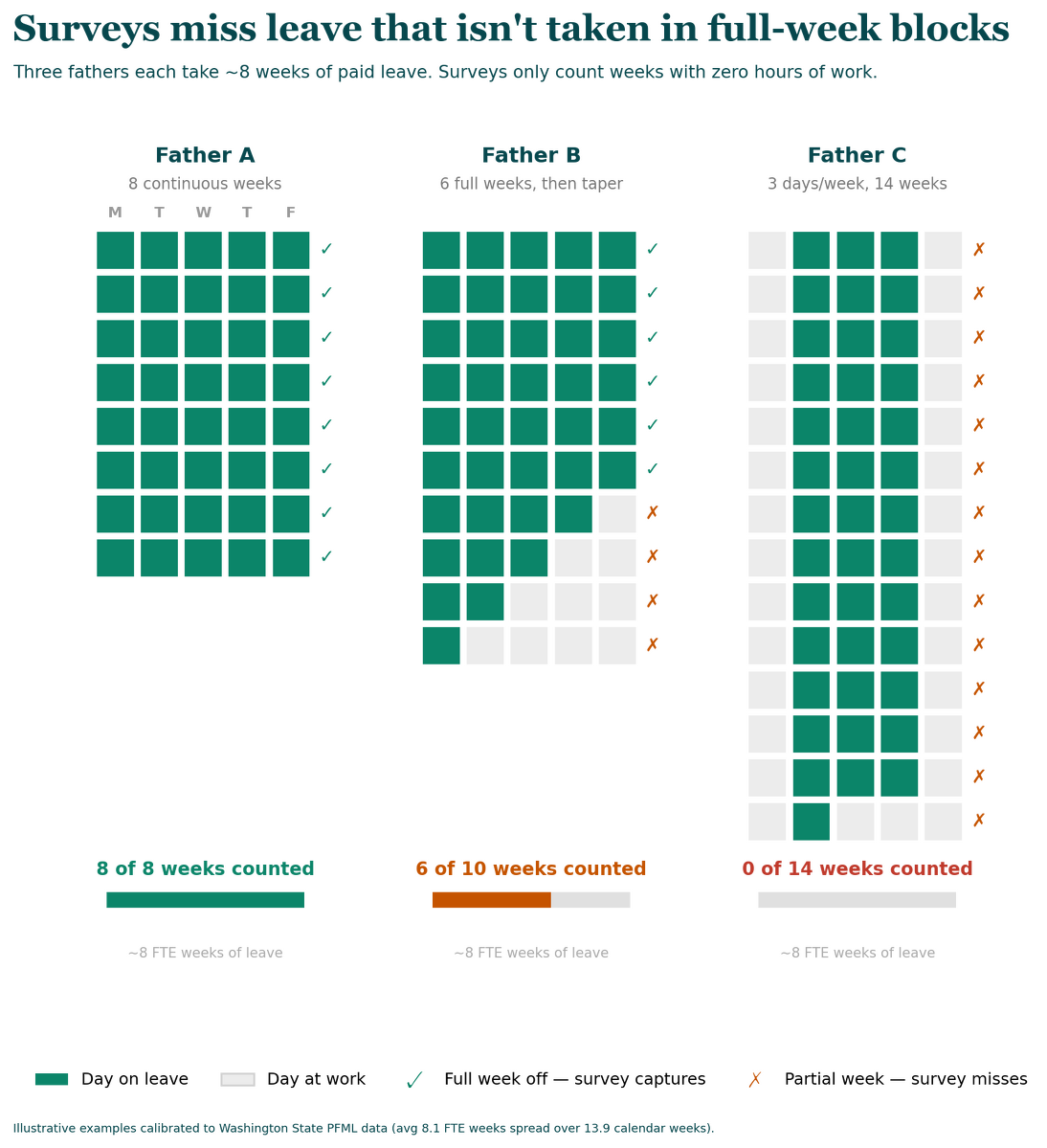
Figure 1
The authors do concede that their method fails to capture intermittent leave. As they put it:
“This measure would not classify those with intermittent or remote work as being on leave, and instead reflects time spent disconnected from work to focus on recovering from childbirth, caring for an infant, or performing other household duties. This measure is consistent with measures used in prior research and in public policy discussions surrounding parental leave, which emphasize bonding time to promote health and child investments.”
They are right that this measure is consistent with how leave has been captured in much of the past research. But that’s a problem when it comes to accurately capturing how fathers take leave, rather than mothers. Continuous stretches of complete disconnection from work may be a reasonable approximation of how most mothers take leave. For fathers, it misses how many of them actually use it. (And time with a newborn surely matters for a child’s bonding and health whether or not it comes in unbroken weeks.). This is not a limitation unique to the Minneapolis Fed paper. But the resulting number—an average of just 0.6 weeks—seriously understates father’s leave-taking.
Policy, and fathers, have changed since 2019
The Minneapolis Fed paper aims to describe parental leave as it stands today, but its data runs only through 2019, and the landscape has changed dramatically since. The window they analyze closes at a turning point, for policy and for fathers themselves.
In 2005, paid family leave as a state program was limited to California. By 2019, a handful of other states had joined: New Jersey (2009), Rhode Island (2014), and New York (2018). Since then, the policy landscape has changed dramatically. Washington and D.C. began paying benefits in 2020. Massachusetts followed in 2021, Connecticut in 2022, Oregon in 2023, Colorado in 2024, and Maryland in 2025. Delaware, Maine, and Minnesota are set for 2026.
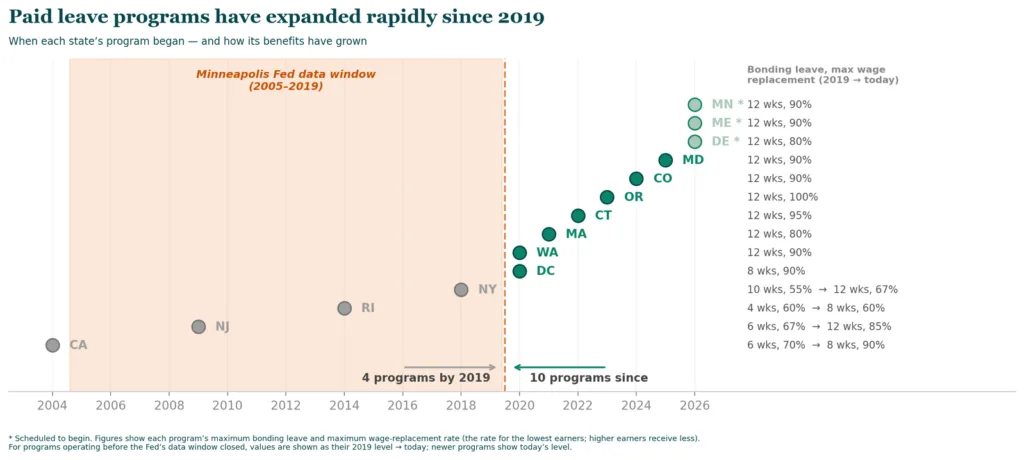
Figure 2
It is not only that many more states have been offering paid leave since 2019, many of the programs themselves have also become dramatically more generous.
Take California, the largest state with a paid family and medical leave (PFML) program. When the program began, California offered 55% wage replacement for a maximum of six weeks. Moreover, fathers whose employers had less than 50 employees had no job protections, meaning those at small firms could be fired for taking leave. The program has since been overhauled in stages: wage replacement rose to 60–70% in 2018, the duration grew from six to eight weeks in 2020, job protection was extended to firms with as few as five employees in 2021, and wage replacement rose again to 70–90% in 2025. Notably, most of this expansion came after 2019—the year the Minneapolis Fed’s data ends. California is not the exception: New Jersey, Rhode Island, and New York have undergone similar expansions. The paid leave programs of today bear little resemblance to their 2010s counterparts.
There is reason to believe that fathers themselves have changed, too. The COVID-19 pandemic appears to have disturbed family norms, and some have stuck: the recent analysis for AIBM by Ari Binder shows that fathers increased their childcare and housework by ~3.6 hours per week between 2019 and the post-pandemic period.
Given the shifts in policy and culture since 2019, we’d expect father’s leave-taking to have changed—and when we look at the updated data, we see that it has.
What up-to-date data shows
We do not have access to the birth-record-linked ACS data used in the Minneapolis Fed report. But we have three other data sources—the Current Population Survey (CPS), a national poll by NORC, and state administrative data. Each has different strengths and limitations. But taken together, they paint a very different picture to the one from the Minneapolis Fed.
The Current Population Survey
Each month, the CPS asks employed Americans who were absent from work during a reference week why they were absent. One of the responses is “maternity/paternity leave.” This allows us to observe reported parental leave directly, rather than inferring from proximity to time of birth.

Figure 3
From 2005 to 2019, the amount of leave taken by fathers as measured by the CPS was low and rising modestly. Since 2019, the rate has roughly tripled. By 2025, our CPS measure implies approximately 1.6 weeks of paternity leave in states that never implemented PFML programs and double that (around 3.3 weeks) in states with PFML programs as of 2025. The gap between PFML and non-PFML states is growing, too.
The CPS estimate is an undercount, however, sharing the full-week blind spot we described above. Like the ACS measure in the Minneapolis Fed paper, it only captures workers who are absent the entire reference week. So while the CPS shows a clear trend post-2019—leave is rising, with growth largest in states that implemented PFML programs—it still almost certainly understates the level of leave-taking today.
New America 2026 Parent Survey
Data from New America’s 2026 Parent Survey provides another estimate of leave-taking—one that better accounts for intermittent leave. The survey, fielded by NORC at the University of Chicago, asked over 2000 fathers of children under six if they took time off from work when their youngest child was born, and if so, how much.


Figures 4 and 5
Because the Parent Survey does not restrict to full weeks off, it captures intermittent leave that the CPS and ACS miss. As Fig 3 shows, consistent with CPS estimates, the Parent Survey finds that the majority of fathers (80%) take time off when a child is born. The estimated total leave taken on average by fathers is three weeks, roughly five times the Fed estimate.
This should not be misunderstood as saying that fathers’ leave-taking is now equivalent to mothers’. Fathers are less likely than mothers to take leave, and long duration leave is not the norm. 80% of fathers take leave, compared to 89% of mothers. Of fathers who do take leave, half take 2 weeks or less, as figure 6 shows.

Figure 6
The issue is not that fathers don’t want to take leave. Half of the fathers surveyed reported taking less time off than they would have wanted. Among fathers who took no time off at all, the median preferred leave duration was 3-4 weeks. Fathers ability to take leave appears to be constrained by practical concerns: whether they live in a state with a PFML program, whether their employer provides generous leave, and whether taking leave will jeopardize their career.
The data shows that fathers report wanting to take more leave—states with generous PFML programs offer a glimpse of what their leave-taking can look like when they are afforded the opportunity to do so.
State administrative data
Survey data still relies on how respondents interpret questions. To see what fathers’ leave-taking looks like in practice, we turn now to administrative data from state paid leave programs. (Paid Leave for All and the National Partnership for Women & Families have likewise drawn on state records to document men’s growing presence among paid-leave claimants). We contacted the ten jurisdictions with mandatory PFML programs active for more than a year: four provided robust data on claim counts by gender, and three also split leave duration by gender. This data allows us to calculate paid leave program participation—and duration—for mothers and fathers respectively.

Figure 7
As figure 7 shows, parental leave uptake among fathers varies substantially, with Washington having the highest uptake of reporting states at 3 in 4, and New Jersey the lowest at 1 in 4. These rates do not reflect fathers who take leave exclusively through vacation days, sick leave, federal paid leave, or informal arrangements. They also count, in the denominator, fathers who are ineligible for their state’s program: the self-employed, workers with out-of-state employers, those below the earnings threshold.
Fathers who take leave through PFML programs take substantial amounts of leave: in the states which provided gender-split duration data, average leave duration among leave-taking fathers ranged from 6.9 to 9.5 weeks.

Figure 8
The state of Washington has a particularly rich dataset which allows us to analyze the timing of leave-taking precisely. In that state, fathers averaged the equivalent of 8.1 weeks of paid leave, but their claims spanned 13.9 calendar weeks on average, as figure 8 shows. That means that fathers are spreading eight weeks worth of leave-hours over nearly fourteen weeks; they are working some days, off others, exactly the intermittent pattern that full-week survey measures miss. The state’s admin data validates that fathers in particular are undercounted: mothers take a similar amount of total leave (8.3 full weeks) but concentrate it into just 10.6 calendar weeks.

Figure 9
Of course leave-taking patterns as measured by administrative data from states with PFML programs are not representative of other states. But they do provide a more robust picture of what leave-taking looks like for fathers and mothers than survey data. And they point to what the leave-taking of fathers can look like when fathers are afforded the opportunity to take it, as they are in a growing number of states.
Conclusion
The Minneapolis Fed’s paper paints a discouraging picture of fathers’ leave-taking. It is not the only one in this vein. But drawing on more recent and more complete sources, a very different and more positive picture emerges. Fathers are taking up the opportunity for paid leave in huge shares, and for substantial periods of time. When paid leave policies are in place, rates and durations of leave-taking increase significantly. The demand from Dads for leave is clear and strong. Paid leave works: for Dads as well as Moms.
Subscribe to our newsletter
Get the latest developments on the trends and issues facing boys and men.
Related Research

Fatherhood & Family, Employment
Men enter teaching to pay it forward
Ben Smith and Jennifer Seelig present findings from a study, in partnership with NORC at the University of Chicago, on the motivations of male teachers and the barriers they faced when entering the profession.

Fatherhood & Family, Employment
Healthcare is the new working-class jobs engine. Can it become a career pathway for men?
While healthcare has emerged as the dominant replacement sector for manufacturing in the U.S. since the early 1980s, much of its growth is concentrated in roles that many men have not historically viewed as natural occupational pathways.

Fatherhood & Family, Employment
What’s really going on with men and work? Seven facts
This brief provides seven key facts about men and work by mapping who is affected, tracing how trends have shifted over time, and confronting the questions we may still not have good answers to.